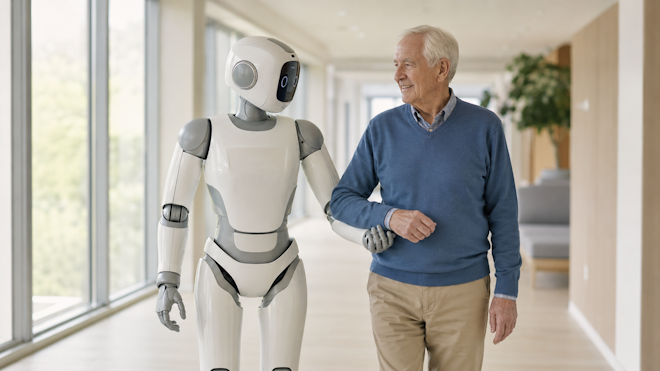
Can humanoid robots guide older adults while walking in a way that feels both safe and comfortable?
And what kind of physical contact creates trust without causing additional stress?
The recent preprint study “Effects of Robotic Touch on Older Users During Walking Guidance by a Humanoid Robot” by Leonie Leven and colleagues from the Karlsruhe Institute of Technologie explores these questions.
Objectively Measuring Physiological Responses
Two movisens research sensors were used:
Gentle Physical Contact Receives a Positive Response
The ECG data indicated a slight tendency toward higher stress during the interaction with the robot: heart rate increased marginally, while the HRV parameters examined decreased slightly.
For electrodermal activity, the response amplitude was slightly higher in some of the contact-based conditions than during contactless guidance.
The subjective and behavioral findings were generally positive. Holding the robot and resting the forearm on it were particularly associated with greater perceived safety, trust, and comfort. The results therefore suggest that older adults may prefer gentle, stable touch during robot-assisted walking guidance to an entirely contactless interaction.
Multidimensional Research Under Realistic Conditions
The study demonstrates the value of a multimodal research approach. Questionnaires alone may reflect conscious evaluations and socially desirable responses. ECG and electrodermal activity complement these reports by capturing continuous and largely involuntary physiological reactions.
This is precisely where the movisens product portfolio offers a wide range of research possibilities. The EcgMove 4 combines ECG and physical activity monitoring in a mobile system. The EdaMove 4 combines electrodermal activity with movement and contextual information. These sensors allow researchers to collect raw data not only in the laboratory but also in ambulatory studies conducted in participants’ everyday lives. Via Bluetooth, selected live parameters can also be connected to the movisensXS experience sampling platform. This makes it possible, for example, to trigger questionnaires or interventions in response to physiological changes or activity-related events.
Building on this approach, future studies could investigate how the acceptance of assistive robots develops over longer periods and in real-world care or clinical settings. Combining objective biosignals, physical activity data, and situation-specific self-reports provides a particularly informative methodological foundation for this research.
And what kind of physical contact creates trust without causing additional stress?
The recent preprint study “Effects of Robotic Touch on Older Users During Walking Guidance by a Humanoid Robot” by Leonie Leven and colleagues from the Karlsruhe Institute of Technologie explores these questions.
Objectively Measuring Physiological Responses
Two movisens research sensors were used:
- The EcgMove 4 recorded a single-channel ECG at a sampling rate of 1,024 Hz. The data were used to calculate heart rate and the heart rate variability parameters RMSSD and pNN50.
- The EdaMove 4 captured electrodermal activity through two Ag/AgCl electrodes at a sampling rate of 32 Hz. The analysis included skin conductance level, the number of skin conductance responses, and their mean amplitude.
Gentle Physical Contact Receives a Positive Response
The ECG data indicated a slight tendency toward higher stress during the interaction with the robot: heart rate increased marginally, while the HRV parameters examined decreased slightly.
For electrodermal activity, the response amplitude was slightly higher in some of the contact-based conditions than during contactless guidance.
The subjective and behavioral findings were generally positive. Holding the robot and resting the forearm on it were particularly associated with greater perceived safety, trust, and comfort. The results therefore suggest that older adults may prefer gentle, stable touch during robot-assisted walking guidance to an entirely contactless interaction.
Multidimensional Research Under Realistic Conditions
The study demonstrates the value of a multimodal research approach. Questionnaires alone may reflect conscious evaluations and socially desirable responses. ECG and electrodermal activity complement these reports by capturing continuous and largely involuntary physiological reactions.
This is precisely where the movisens product portfolio offers a wide range of research possibilities. The EcgMove 4 combines ECG and physical activity monitoring in a mobile system. The EdaMove 4 combines electrodermal activity with movement and contextual information. These sensors allow researchers to collect raw data not only in the laboratory but also in ambulatory studies conducted in participants’ everyday lives. Via Bluetooth, selected live parameters can also be connected to the movisensXS experience sampling platform. This makes it possible, for example, to trigger questionnaires or interventions in response to physiological changes or activity-related events.
Building on this approach, future studies could investigate how the acceptance of assistive robots develops over longer periods and in real-world care or clinical settings. Combining objective biosignals, physical activity data, and situation-specific self-reports provides a particularly informative methodological foundation for this research.