movisensXS App Version 1.5

SensorTrigger functionality fully integrated in movisensXS

We're proud to announce that the sensor trigger for Experience Sampling and Ecological Momentary Assessment studies is now out of Beta. Now you can implement innovative research ideas by coupling one of our class leading activity sensors with movisensXS - our intuitive and comprehensive experience sampling platform - to capture truly insightful data.


Our research grade sensors analyze physiological parameters in real time and transmit the results via Bluetooth Smart. This allows individually configurable algorithms to trigger forms in movisensXS based on changes in physiology that the researcher wants to examine. By implementing one of our existing algorithms, the detection of physiological changes, such as high activity levels, sedentary behaviour, heart rate variability (RMSSD), and heart rate thresholds (among many others), can act as a trigger within your EMA/ESM study.

You have the freedom to select different algorithms for each individual participant, and also further customize the existing algorithms within groups. There's a range of existing algorithms developed for specific research projects that provide a small sampling of what is possible with this innovative technology.
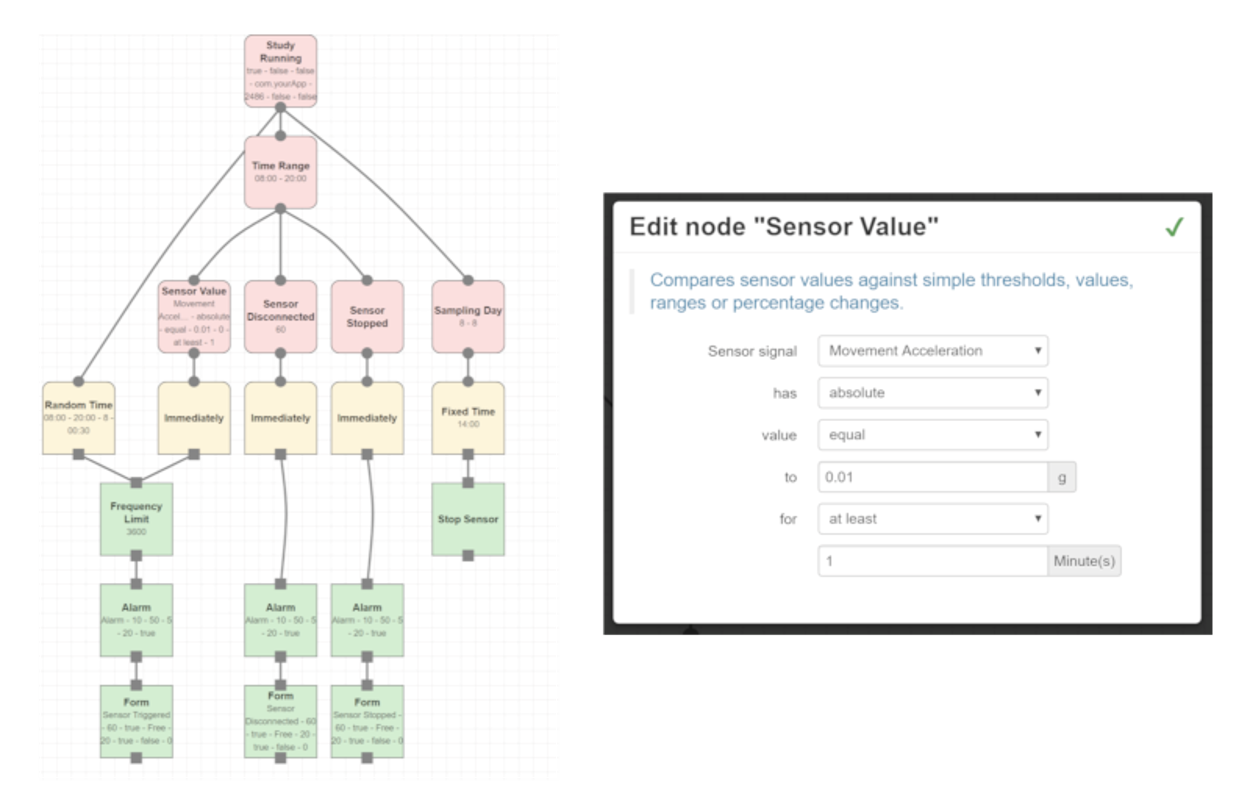


If you have an existing algorithm that you would like to utilize, or an idea for a physiological marker that you would like to have as a trigger, we can work with you to implement this idea and develop your study.

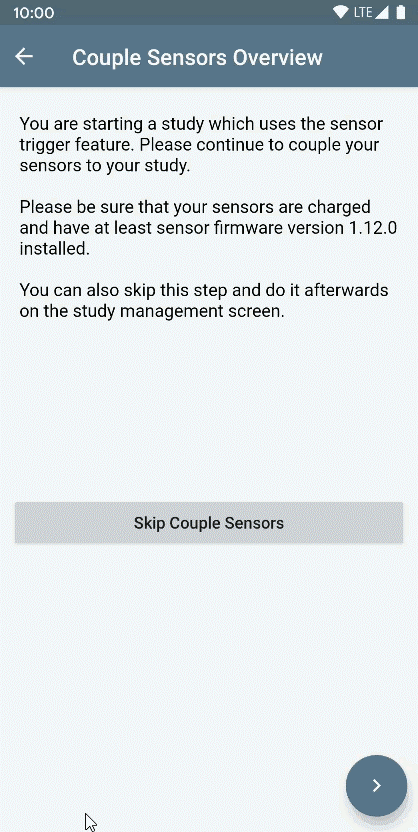
Since the Beta we have added the possibility to skip the coupling of sensors when starting a study, allowing you to couple or re-couple sensors later.

If you want to use the movisens Sensor trigger feature please drop us a line under support@movisens.com and tell us the Email address of your movisensXS account so we can grant you access to the feature. The full documentation describing the features can be found in our docs website.

Improved wizard for sending debug information

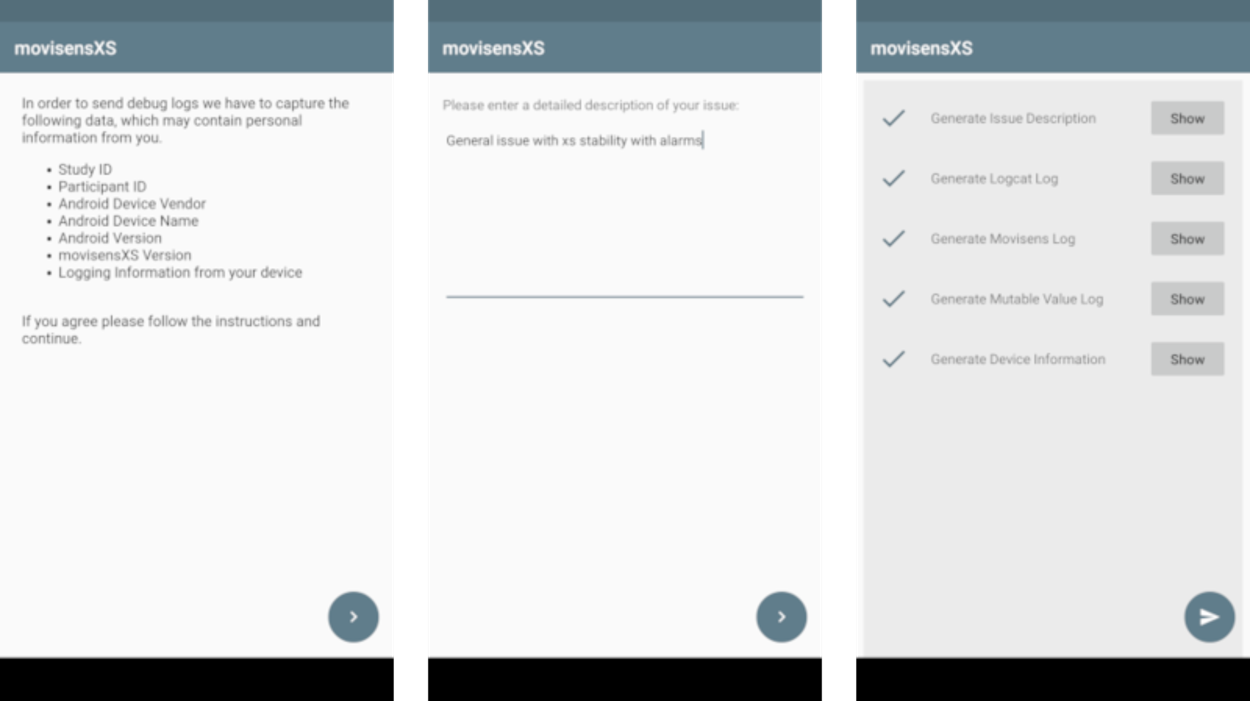
In case a study does not run correctly on a particular smartphone you can send us debug information from the Settings Screen. It is now required to type some description of the problem. This helps us to spot possible problems and continue to improve the user experience for everyone.


More Improvements

  • Added Android 9 compatibility
  • Fixed bug with Android Oreo or higher where notification sound can't be defined after startup anymore
  • Added new dnd mode detection and prevention
  • Changed behaviour in case of unexpected app restarts, which occasionally caused studies not to function in some rare cases
  • Replaced Google Cloud Messaging with Firebase Cloud Messaging
  • Fixed problems with DnD mode permission not being available in devices
  • Fixed notification sound and channels with all different android versions
  • Fixed bug in mutable values if they start with a whitespace
  • Added possibility to disable the feedback for the cognitive Tests PVT and SART
  • Fixed smaller bugs

Improvements of beta features (available on request)

  • Changed Sampling Block "Log device running" to log every minute
  • Added new "One Of" block to select randomized actions like forms
  • Added possibility to analyze the results on an external server and trigger actions based on the analysis
  • Added "Multi Geofence Trigger" which allows the specification of multiple geofences in a csv file
  • Added "Log Static Locations" block and "Label Static Locations" item to record and label static locations of a participant during a study
  • Added new "Play Sound Repeatedly" item

The next app release

Warning: The next release will drop the support for Android versions below Android 4.4. We have to do this step to increase the security of the encrypted data transfer as recommended by the Federal Office for Information Security (BSI). Please make sure that you finish your study on Phones with Android lower than 4.4 in the next month and upload all data from these devices before 01.04.2020 otherwise you are not able to upload the data any more. As always, let us know if you have any questions. Please spread the word and tell your colleagues about our great new features.

Ambulatory Assessment

Over the next few months we're going to be running a few long form articles on the news blog along with our regular news updates and product launches. For the first series of articles, we're going to talk a little bit about the origins of Ambulatory Assessment, it's development with technological advances, and some of the exciting future research possibilities that it allows. We hope you enjoy!

Ambulatory Assessment

A short summary of the current methodologies

Studying people in their natural habitat is no longer exclusively the domain of anthropologists in the wild. The jungle and the savannah no longer resemble the day to day experiences of modern urban dwelling homo-sapiens. However the legacy of our past is still locked within our psyche, and unravelling our psychological nature involves researchers utilizing new methods to delve deeper in to our minds and bodies.

The overarching ‘umbrella’ for all of the following research methods is Ambulatory Assessment. Whether you’re performing an Ecological Momentary Assessment or Experience Sampling study, they fall within the scope of Ambulatory Assessment.

The core idea of Ambulatory Assessment is to track parameters outside of the laboratory or clinic. Using electronic diaries and/or physiological sensors, researchers can cast aside the inaccuracy of patient reporting and gain valid real time or near real time data. Data not contaminated by the fallibility of participant recollection or miss reporting, and this allowed researchers a purer glimpse of the “… rich information about the daily lives of individuals who may be studied or treated by clinical scientists and mental health professionals.” (Trull & Ebner-Priemer, 2013)

The best and most concise definition of Ambulatory Assessment comes from the Society for Ambulatory Assessment website:

“Ambulatory Assessment comprises the use of field methods to assess the ongoing behavior, physiology, experience and environmental aspects of people in naturalistic or unconstrained settings. Ambulatory Assessment uses ecologically-valid tools to understand biopsychosocial processes as they unfold naturally in time and in context.”

Whilst Experience Sampling and Ecological Momentary Assessment and Daily Diary Studies are components of Ambulatory Assessment, this term often conjures Physiological Monitoring to mind. Research papers that cite Ambulatory Assessment in their keywords often utilize accelerometers, ECG, and other physiological parameters as the core data in their study.

So that brings us on to Ecological Momentary Assessment and Experience Sampling, two of the key components of Ambulatory Assessment, and just like Ambulatory Assessment, Ecological Momentary Assessment doesn’t really sound that catchy. Now, there’s a subtle difference between EMA and Experience Sampling. First I’ll pass it over to Reed Larson and Mihaly Csikszentmihalyi to recite the abstract from their 1983 article that defined the Experience Sampling Method:

“…the Experience Sampling Method (ESM), a research procedure that consists of asking individuals to provide systematic self-reports at random occasions during the waking hours of a normal week....The ESM obtains information about the private as well as the public aspects of individuals' lives, secures data about behavioral and intrapsychic aspects of daily activity, and obtains reports about people's experiences as they occur, thereby minimizing the effects of reliance on memory and reconstruction.”

Whilst gathering information from people during their daily lives is the primary role of Experience Sampling, the term has become used to describe gathering subjective data over time even within the laboratory or clinical setting. Now, let’s get back to Ecological Momentary Assessment. To perform great craftsmanship, a tradesman requires good tools, and for the researcher Ecological Momentary Assessment (EMA) is an incredibly powerful longitudinal study tool for harnessing subjective data in day to day life. The subtle difference between EMA and ESM (experience sampling methodology) lies in the origins of the two methods. EMA emerged out of the field of behavioral medicine, and as a result often includes physiological parameters or health related questions, and is primarily performed in a person’s day to day normal environment.

In the next part of this series, we’ll delve in to the advantages and drawbacks of Ambulatory Assessment, and discuss the impact of developing technology.

Neues White Paper zu Aktivitätsalgorithmen

Our very own Florian Richert crafted a fascinating white paper about the difficulties of accurately assessing energy expenditure using actigraphy. He details the history of interpreting accelerometer data, highlighting the advantages of a transparent method of calculation and the importance of capturing raw data in the sensor. Focusing on the quest to accurately estimate energy expenditure, Florian delves in to the existing research and reveals the weaknesses in the current approach and the way forward to develop a sustainable method of calculating parameters from accelerometer data as newer and better algorithms are devised.

The paper carves through the different existing methodologies and presents solid recommendations for integrating high quality accelerometer data in future research. In particular, utilising physiological data to assist in capturing psychological data in an ambulatory setting.

We hope you enjoy it.

Click here to download

Unsere Distributoren

Als ein weltweit führendes Unternehmen für Lösungen im ambulanten Assessment baut movisens sein Vertriebsnetzwerk stetig aus, und freut sich, ihnen neue Partner vorstellen zu können, die den Vertrieb unserer Produkte unterstützen.

Eine Übersicht über unsere Distributoren finden sie hier.

movisens auf der 9. SGS-Tagung in Zürich

movisens wird auf der 9. Jahrestagung der sportwissenschaftlichen Gesellschaft der Schweiz (SGS), die vom 09. – 10.02.2017 an der ETH Zürich stattfinden wird, als Aussteller vertreten sein. Bei dieser Tagung werden zahlreiche Vorträge und Posterpräsentationen unter dem Motto „Sport und Gesundheit“ gehalten. Zusätzlich werden Arbeitskreise angeboten, in denen über aktuelle Forschungsarbeiten berichtet und diskutiert werden darf. Wir würden uns freuen Sie bei dieser Veranstaltung in Zürich an unserem Stand begrüßen zu dürfen, um Ihnen unsere neusten Entwicklungen im Bereich des mobilen Monitorings und ambulanten Assessments  vorstellen zu dürfen.

Verhaltensmedizin 2.0 – von eHealth zu mHealth

"Smartphones eröffnen die Möglichkeit, alltagsnah Erleben und Verhalten zu erfassen. Über Schnittstellen zu physiologischen Messsystemen können zentrale physiologische Kenngrößen und objektive Gesundheitsdaten in situ miterfasst werden und einer modernen Verhaltensmedizin neue Wege für Forschung, Prävention und Intervention bieten." Die Beschreibung des 15. Kongress der Deutschen Gesellschaft für Verhaltensmedizin und Verhaltensmodifikation vom 25.- 27. Februar 2016 an die Johannes Gutenberg-Universität Mainz umfasst die gesamte Produktpalette von movisens. Auf unserem Stand werden während des gesamten Kongresses die neuesten Generationen unserer Sensoren für die mobile Messung psycho-physiologischen Parameter und körperlicher Aktivität vorgestestellt. In Verbindung mit unserer Experience Sampling Plattform movisensXS bieten sie die Möglichkeit für das Interaktive Ambulante Assessment. Interessenten können sich entweder in der Ausstellung oder in einem Workshop über die Funktionen unsere Systeme informieren. Gerne können wir auch einen individuellen Termin mit ihnen vereinbaren.

Gesundheit messen – Gesundheit fördern

Das Motto des 12. Kongresses der Fachgruppe Gesundheitspsychologie, der diese Jahr vom 17.09.-19.09. in Graz stattfindet, beschreibt eine der Kernkompetenzen von movisens. Am Stand auf dem Kongress wird die neue Generation unserer Sensoren für die mobile Messung psycho-physiologischen Parameter und körperlicher Aktivität vorgestestellt. In Verbindung mit unsere Plattform movisensXS bieten sie die Möglichkeit für das Interaktive Ambulante Assessment.
In verschiedenen Beiträgen im Rahmen des Kongressprogrammes werden unterschiedliche Studien vorgestellt, die mit Lösungen von movisens durchgeführt wurden.

ICAMPAM Konferenz in Limerick

movisens wird auf der "4th International Conference on Ambulatory Monitoring of Physical Activity and Movement (ICAMPAM)", die von der International Society for the Measurement of Physical Behaviour (ISMBP) in diesem Jahr vom 10. - 12.Juni in Limerick, Irland durchgeführt wird als Aussteller und mit einem Posterbeitrag vertreten sein. Auf der Konferenz werden in Key Notes, Präsentation und Workshops Diskussionen über die Entwicklungen in Theorie, Methoden und Ergebnissen im Bereich der Messung von körperlicher Aktivität und Bewegung angeregt werden. Wir würden uns sehr freuen, sie auf der Konferenz an unserem Stand begrüßen zu können, um ihnen die neuesten Entwicklungen von uns in diesem Bereich präsentieren zu können.

ISBNPA Konferenz in Edinburgh

movisens wird als Aussteller auf der diesjährigen Konferenz der International Society for Behavorial Nutrition & Physical Activity (ISBNPA) in Edinburgh vertreten sein, die vom 3.6. - 6.6.2015 stattfindet. Das Programm enthält Key Note Beiträge von führenden Wissenschaftler sowie eine Vielzahl von Vorträgen und Postern mit aktuellen Ergebnissen und Fortschritten in Theorie und Methoden im Bereich der körperlichen Aktivität und des Ernährungsverhaltens. Wir würden uns freuen, sie auf der Veranstaltung an unserem Stand begrüßen zu können. Gerne können sie auch im Vorfeld einen individuellen Termin mit uns vereinbaren. Mehr Informationen finden sie hier: https://www.isbnpa.org/index.php?r=annualMeeting/index&year=2015